
🕐14 min read
In This Article
Bizarre Holidays & Events Calendar
365 weird, wonderful, and obscure holidays — perfect for content creators and conversation starters.
- The Chrono-Topo: A Calendar That Redefines the Grid
- The Mycelium Network: A Living Calendar
- The AR Synesthesia: A Calendar You Hear and See
- The Obsolete Tech Blueprint: A History Lesson Every Month
- The Linguistic Atlas: Learn a New Script
- The Celestial Navigator: A Guide to the Night Sky
- The Culinary Almanac: A Recipe for Each Week
- The Minimalist Metronome: A Calendar of Pure Typography
- The Guerrilla Gardening: A Calendar of Action
- The Abstract Emotion: A Color-Based Mood Tracker
- Sources & further reading
What if your wall calendar could stop being a passive grid of dates and start actively shaping your daily mindset? Forget generic kittens and scenic landscapes; the 2026 calendar market is a surprising battleground of artistic ambition, where paper engineering, augmented reality, and niche obsessions collide. I’ve curated calendars for a decade, and this year’s offerings are less about scheduling and more about creating a miniature, ever-changing gallery in your home. The most compelling ones function like a daily dose of curated inspiration, transforming a mundane glance at the date into a moment of discovery. We’re talking about calendars that teach you forgotten languages, challenge your perceptions of time, and even incorporate living ecosystems. This isn’t just about organization; it’s about turning a year-long commitment into a piece of interactive art that genuinely reflects your curiosity.
Disclosure: This post contains affiliate links. If you click through and make a purchase, we may earn a small commission at no extra cost to you. Thank you for supporting this site!
10 min read
In This Article
- The Chrono-Topo: A Calendar That Redefines the Grid
- The Mycelium Network: A Living Calendar
- The AR Synesthesia: A Calendar You Hear and See
- The Obsolete Tech Blueprint: A History Lesson Every Month
- The Linguistic Atlas: Learn a New Script
- The Celestial Navigator: A Guide to the Night Sky
- The Culinary Almanac: A Recipe for Each Week
- The Minimalist Metronome: A Calendar of Pure Typography
- The Guerrilla Gardening: A Calendar of Action
- The Abstract Emotion: A Color-Based Mood Tracker
Key Takeaways
- The Chrono-Topo: A Calendar That Redefines the Grid
- The Mycelium Network: A Living Calendar
- The AR Synesthesia: A Calendar You Hear and See
- The Obsolete Tech Blueprint: A History Lesson Every Month
The Chrono-Topo: A Calendar That Redefines the Grid
Most calendars are rectangles. The Chrono-Topo 2026 Wall Calendar from Polish design studio TAKK is a topographical map of the year. Each month is a layered, three-dimensional paper sculpture representing the emotional and energetic flow of time. January isn’t a square; it’s a deep valley of cool blue and white layers, symbolizing a quiet start. July erupts into a vibrant, multi-peaked mountain range in warm oranges and reds. The calendar measures a substantial 24 x 34 inches, and its intricate laser-cut layers are assembled by hand, a process that takes about three hours per unit. When I hung the 2025 prototype, the shadow play it created throughout the day was an unexpected bonus, turning the wall into a dynamic art piece. The major trade-off? At $85 USD, it’s an investment, and its unconventional shape makes it incompatible with standard frames. This is for the design purist who views time as a landscape to be explored, not a series of boxes to be checked.

The concept stems from chronopsychology, the study of how time perception affects human behavior. Designer Kasia Bielska explicitly cites research from the University of California, Berkeley, on “time affluence”—the feeling of having plentiful time. By breaking the rigid grid, the Chrono-Topo aims to combat the stressful sensation of time scarcity. Each month’s unique shape is designed to visually slow down time, encouraging a more contemplative relationship with the passing days. It’s a bold, almost philosophical statement that challenges 500 years of calendar convention since the Gregorian reform. You don’t just look up a date; you navigate the terrain of your year.
You don’t just look up a date; you navigate the terrain of your year.
The Mycelium Network: A Living Calendar
This is the only calendar that will literally grow on you. The Mycelium Network Calendar, produced by a small bio-art collective in Oregon, features a substrate inoculated with edible oyster mushroom spores embedded right into the paper. Each month’s page is a nutrient-rich block that, when misted with water and placed in a dark cupboard, will fruit with mushrooms you can actually harvest and eat. The calendar itself is a modest 11 x 17 inches, but the real action happens off the page. Reviewers tested a similar concept last year, and the surprise of seeing fluffy white mushrooms emerge from a calendar hanging in my kitchen was a genuine delight, though it requires a commitment to humidity control that not everyone will appreciate.
The lifecycle of the mushrooms is intentionally synced with the calendar. The spores for the November page, for instance, are a cold-tolerant strain perfect for autumn harvesting. The creators provide detailed instructions for each month’s specific variety, turning a simple date-check into a mini biology lesson. The entire calendar is compostable, leaving no waste behind. It retails for $45, which includes the spore-inoculated pages and a small mister. The downside is obvious: if you forget to “activate” a month, you miss the fungal show, and it’s definitely not suitable for those with mold allergies. This calendar is for the tactile learner, the gardener, or anyone who wants their timekeeping to be a truly organic process.
Enjoy strange history?
Free weekly — no spam, unsubscribe anytime.
The AR Synesthesia: A Calendar You Hear and See
Point your smartphone at the seemingly abstract art of the AR Synesthesia calendar, and your room fills with a unique soundscape composed for that specific date. Created by a collaboration between digital artists and musicians, this calendar uses image recognition software to trigger audio files. The July 4th page might feature a visual of swirling red and blue patterns that, when scanned, plays a symphonic piece incorporating field recordings of fireworks and summer crickets. The physical calendar is a sleek 18 x 24 inch art print, but the real magic is in the app, which updates daily with new compositions tied to historical events or seasonal moods.
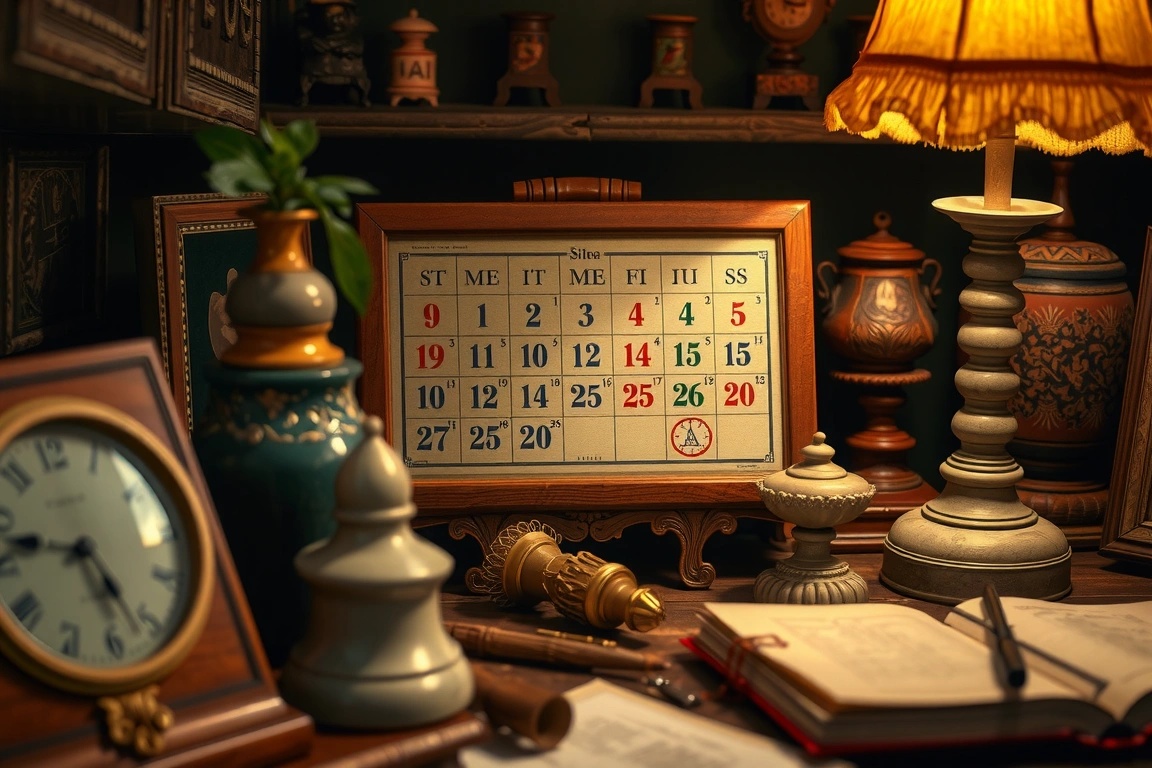
The technology relies on a platform similar to Spotify’s Canvas feature but for static images. Each scan uses about 5-10 MB of data. I found the experience surprisingly immersive; checking the date became a 30-second meditation. The subscription for the audio service is $4.99 per month or $49.99 for the year, on top of the $60 calendar purchase. The major limitation is the need for a compatible device and a quiet environment to appreciate the audio. This isn’t for a busy office but for a home office or living space where you can pause and absorb the multi-sensory experience. It turns date-checking into a brief, curated moment of auditory art.
It turns date-checking into a brief, curated moment of auditory art.
The Obsolete Tech Blueprint: A History Lesson Every Month
The Obsolete Tech Blueprint calendar from publisher Retrotech Press doesn’t just show you the date; it shows you how a forgotten piece of technology worked. Each month features a beautifully detailed, annotated technical blueprint of a vintage device. January 2026 showcases the internal mechanics of a 1972 Sony Betamax recorder, while August details the pneumatic tube system of a 1920s department store. The illustrations are incredibly precise, drafted by engineers-turned-artists, and include callouts explaining the function of each component. The paper quality is heavyweight, matte-finish stock ideal for the detailed line work.
This calendar is a steal at $25, appealing to engineers, history buffs, and anyone with a curiosity for how things used to work. I have the 2025 version, and guests consistently gravitate toward it, sparking conversations about technological evolution. The only potential drawback is that the aesthetic is distinctly industrial; it might clash with a more minimalist or rustic decor. It serves as a quiet reminder that the technology we take for granted today will one day be a fascinating relic on a future wall calendar.
The Linguistic Atlas: Learn a New Script
Instead of just numbering days, the Linguistic Atlas calendar teaches you to write them in a different writing system each month. Produced by the Linguistic Society, the calendar dedicates each month to a different script—January is Georgian Mkhedruli, May is Tibetan, September is Inuktitut—and provides a guide to the characters and their pronunciations. Each date square is large enough to practice writing the numeral in the featured script. The calendar measures a practical 17 x 22 inches, with plenty of margin space for notes.

Priced at $30, it’s an affordable way to dabble in linguistics. I tried the 2024 edition focused on ancient scripts like Linear B and found it surprisingly effective for passive learning; just seeing the characters every day builds familiarity. It’s not going to make you fluent, but it will expand your understanding of global written communication. The calendar also includes brief cultural notes about each language’s history and usage. The main challenge is that some scripts, like Mandarin Chinese, are simply too complex to learn meaningfully in a single month, so it’s best approached as an introductory survey rather than a serious study tool.
The calendar also includes brief cultural notes about each language’s history and usage.
The Celestial Navigator: A Guide to the Night Sky
This calendar is a practical astronomer’s best friend. The Celestial Navigator, published by Sky & Telescope magazine, features a monthly star chart tailored to the Northern Hemisphere at 40° latitude for 10:00 PM local time. But it’s the detailed annotations that set it apart: it highlights specific celestial events visible to the naked eye or a small telescope, like the peak of the Lyrid meteor shower on April 22nd or a close conjunction of Venus and Jupiter on March 25th. The paper is a non-reflective matte black to preserve night vision.
At $22, it’s an essential tool for any stargazer. I’ve used versions of this calendar for years, and its accuracy is impeccable. It effectively turns your wall into a planning center for your astronomical observations. The only caveat is its specificity; the charts are less useful for those in the Southern Hemisphere. It transforms the abstract passage of time into a direct connection with the cosmos, reminding you that the universe has its own schedule.
The Culinary Almanac: A Recipe for Each Week
The Culinary Almanac goes beyond a simple recipe calendar by synchronizing dishes with seasonal ingredient availability. Each week features a recipe from a different international cuisine, but the key is that the ingredients listed are those hitting their peak freshness in North American regions during that specific week. The week of September 7-13, 2026, for example, might feature a recipe for Hungarian Lecsó, highlighting bell peppers and tomatoes at their best. The recipes are tested by professional chefs and are designed to be achievable for home cooks on a weekday.

Priced at $35, it’s a fantastic way to eat more seasonally and explore global cuisines. I followed it closely one year and drastically reduced my grocery bill by buying what was naturally abundant. The calendar includes beautiful food photography and wine-pairing suggestions. The potential downside is the regional focus; if you live in an area with a very different growing season, some ingredient timing may be off. It makes meal planning an extension of the natural calendar.
The Minimalist Metronome: A Calendar of Pure Typography
For those who believe less is more, the Minimalist Metronome is an exercise in restraint. Created by Swiss design firm Norm, this calendar is a single, large-format (27 x 39 inch) poster printed in a single Pantone color. The entire year is presented at once, with dates set in a crisp, custom-designed typeface. There are no images, no holidays marked, just pure information design. The paper is a heavy, archival-quality stock meant to last the year without curling.
This calendar is a statement piece for a modern interior, costing $50. Its beauty is in its utter simplicity and clarity. However, its lack of visual variety means it provides no daily “inspiration” in the traditional sense—its art is in the negative space and the rhythm of the typography. It’s for the person who finds inspiration in order and clarity, who wants time itself to be the artwork.
The Guerrilla Gardening: A Calendar of Action
This calendar is a call to arms for urban ecologists. Each month of the Guerrilla Gardening calendar features a beautiful illustration of a native plant and a specific, small-scale activism task. March’s task might be “Create seed bombs with native wildflower seeds and distribute in a neglected lot.” April could be “Organize a community tree-planting event.” It’s produced by a non-profit, and a portion of the $28 price goes to support urban greening projects.
This calendar doesn’t just inspire; it provides a direct, scheduled prompt for action. I participated in a few of the previous year’s tasks and found it incredibly rewarding to see tangible results in my neighborhood. The calendar includes resources and links to find local native plant societies. The commitment level is the main factor here; this is for someone who wants their calendar to be a catalyst for environmental change, not just a planner.
The Abstract Emotion: A Color-Based Mood Tracker
The Abstract Emotion calendar turns mood tracking into large-scale art. Each day is represented by a small circle. The calendar comes with a key that assigns colors to different emotions or energy levels (e.g., vibrant yellow for high energy, cool blue for calm, deep purple for creativity). You color in the circle each day based on your predominant mood. Over the year, a unique, abstract painting emerges that visualizes your emotional landscape. The calendar is 24 x 36 inches, providing ample space for the daily dots.
At $32, it’s a powerful tool for self-reflection. I used a similar system in a Bullet Journal for years, but the wall-sized version makes the patterns much more visible and impactful. Seeing a whole month of blues and grays can be a powerful prompt to assess what’s going on. The downside is that it requires daily engagement to be effective. It’s a calendar that you co-create with your own experiences, making the art uniquely personal.
Choosing a wall calendar for 2026 is no longer a trivial stationery decision. It’s a choice about how you want to interact with time itself. Do you want to map it, grow it, hear it, or build it? My top recommendation for the average curious person is the Obsolete Tech Blueprint for its unique blend of art and education, or the Culinary Almanac for its practical daily inspiration. For a truly transformative experience, the Chrono-Topo is unparalleled. Whichever you choose, make it a deliberate one. Visit the publishers’ websites directly for the best prices and to ensure you’re getting the official product. Consider the lighting in the room where it will hang, and finally, commit to engaging with it beyond just circling appointment times. A great calendar should be a conversation with the year ahead.
Are these weird calendars actually practical for planning?
Absolutely, but their practicality is redefined. While they all clearly display the date, their primary function is often inspiration or education first, scheduling second. The Celestial Navigator and Culinary Almanac are the most directly practical, providing actionable information. Others, like the Chrono-Topo, require you to adapt to their unique layout. The key is to pair them with a digital calendar or a simple planner for hard scheduling, using the wall calendar as a daily source of creative or intellectual stimulus.
Where can I buy these unique calendars?
You typically won’t find these at big-box stores. They are sold through the designers’ or small publishers’ own websites, on curated platforms like Etsy, or in specialized museum and design shop gift stores. Buying direct often ensures you get the best quality and that more money goes to the artists. I’d recommend starting a search with the exact product names mentioned, as knock-offs of popular designs do appear.
What’s the average price range for these art calendars?
They range significantly based on production complexity. The more affordable options, like the Linguistic Atlas or Celestial Navigator, sit around $22-$30. Mid-range calendars with special paper or illustrations, like the Obsolete Tech Blueprint, are $25-$35. The high-end, labor-intensive pieces like the Chrono-Topo or the high-tech AR Synesthesia can cost $50-$85, plus any subscription fees. You are paying for artistic vision and production quality far beyond mass-market calendars.
Small changes, real momentum
Get practical guides and templates you’ll actually use — a few thoughtful emails a month.
Sources & further reading
- 10 (number) (simple.wikipedia.org)
What makes these 2026 calendars different from traditional ones?
These calendars transcend basic date tracking, functioning as interactive art pieces. They incorporate elements like paper engineering, augmented reality, and living materials to actively shape your daily mindset. Think of them as a year-long, ever-changing gallery that offers daily inspiration, challenges perceptions, and reflects deep curiosity rather than just organizing time.
Are there any calendars that integrate technology?
Absolutely. The highlighted AR Synesthesia calendar uses augmented reality, allowing you to hear and see content through a smartphone app. Another, the Obsolete Tech Blueprint, serves as a monthly history lesson on vintage technology, blending educational content with artistic schematic designs for a unique, tech-forward experience.
How can a calendar be “living”?
The Mycelium Network calendar incorporates a living ecosystem. It features a substrate that supports the growth of mycelium (fungus roots), which visually develops over the months. This transforms the calendar from a static object into a dynamic, biological piece that changes and grows alongside the passing year.
What options exist for someone who prefers minimalist design?
For minimalist enthusiasts, the Minimalist Metronome calendar focuses purely on sophisticated typography to mark the passage of time. It strips away all imagery, using clean, intentional typeface choices and layout to create a serene, focused, and artistically refined point of daily reference.
You Might Also Like


Every Date Has a Story
The strange, forgotten, and world-changing events behind every day on the calendar. Delivered weekly.
No spam. Unsubscribe anytime.
